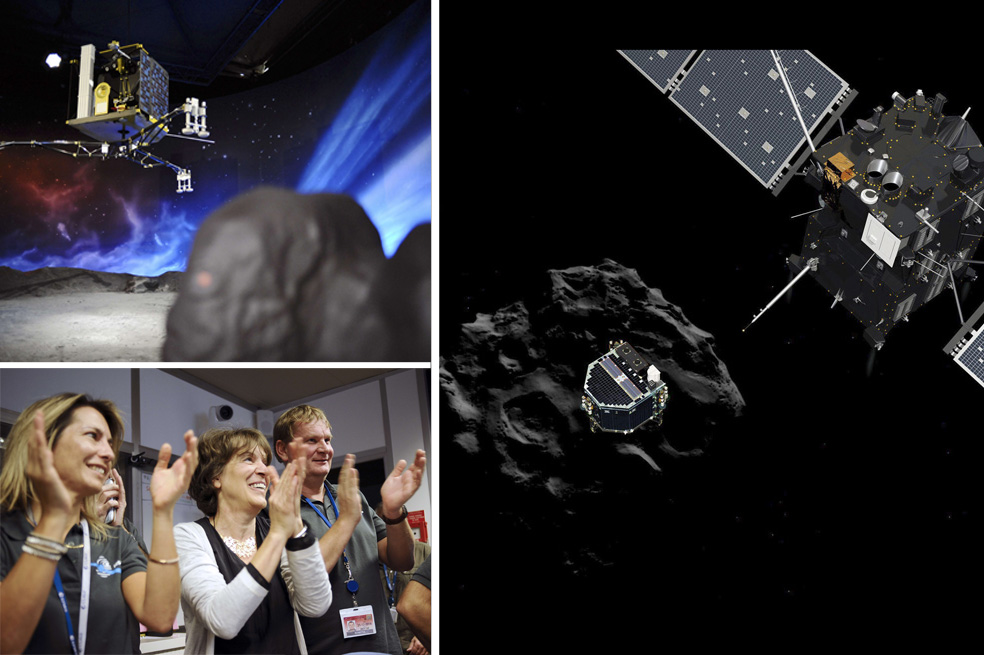
Scientists celebrate in the scientific mission observation centre of the French space agency Centre National d'Etudes Spatiales (CNES) in Toulouse, southern France, on November 12, 2014, as they receive information that the European Space Agency's (ESA) robot craft Philae has landed on the Churyumov-Gerasimenko comet after a 20-kilometre (12-mile) descent from its carrier the European space probe Rosetta, following a ten year journey. The European probe Philae has made the first-ever landing on a comet, a crowning phase in a quest to explore the origins of the Solar System, the European Space Agency (ESA) said on November 12. Scientists hope the lander, equipped with 10 instruments, will unlock the secrets of comets — primordial clusters of ice and dust that may have helped sow life on Earth. AFP PHOTO / REMY GABALDA
Foto: AFP - REMY GABALDA

(FILES) — This photo released by the European Space Agency on December 20, 2013 shows an artist impression of Rosetta's lander Philae (back view) on the surface of comet 67P/Churyumov-Gerasimenko. Philae will be deployed to the comet on November 12, 2014 where it will make in situ observations of the comet surface, including drilling 23cm into the subsurface to extract material for analysis in its on board laboratory. AFP PHOTO / ESA MEDIALAB
RESTRICTED TO EDITORIAL USE – MANDATORY CREDIT "AFP PHOTO / ESA MEDIALAB" – NO MARKETING NO ADVERTISING CAMPAIGNS – DISTRIBUTED AS A SERVICE TO CLIENTS
Foto: AFP - MEDIALIAB

= RESTRICTED TO EDITORIAL USE – MANDATORY CREDIT "AFP PHOTO / ESA/Rosetta/NavCam /HANDOUT" – NO MARKETING NO ADVERTISING CAMPAIGNS – DISTRIBUTED AS A SERVICE TO CLIENTS =
This image obtained from ESA on November 10, 2014 shows the Agilkia landing site on this image of Comet 67P/ChuryumovGerasimenko, taken with Rosettas navigation camera on 6 November, just days before its lander Philae makes its historic descent to the surface. The image presented here is a mosaic of four individual NavCam frames, captured from a distance of 30.5 km from the comet centre on 6 November while Rosetta was en route to the separation trajectory from which it will deploy Philae on 12 November. AFP PHOTO / ESA/Rosetta/NavCam /HANDOUT
Foto: AFP - –
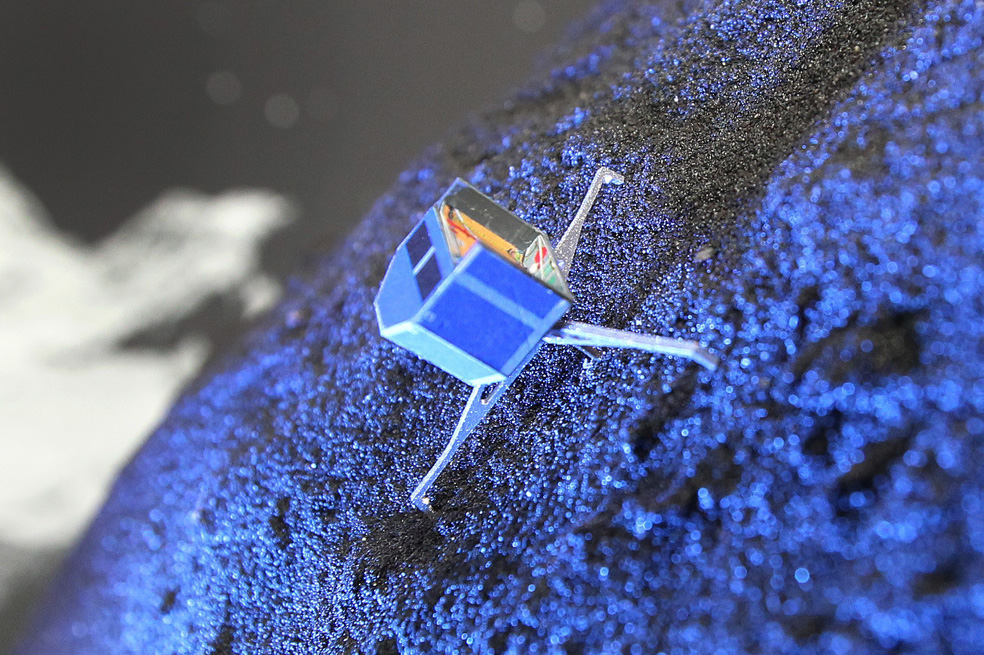
A model of the landing module "Philae" is pictured at the ESA/ESOC (European Space Agency / European Space Operation Center) in Darmstadt, western Germany, on November 12, 2014, as European probe Philae is poised to land on a comet, the culmination of a historic quest to explore an enigma of the Solar System. After a trek of more than a decade, the mini lab called Philae separated on schedule from its mother ship Rosetta. Philae is to land on 67P/Churyumov-Gerasimenko, a comet now more than 510 million kilometres (320 million miles) from Earth and racing towards the Sun. AFP PHOTO / DANIEL ROLAND
Foto: AFP - DANIEL ROLAND
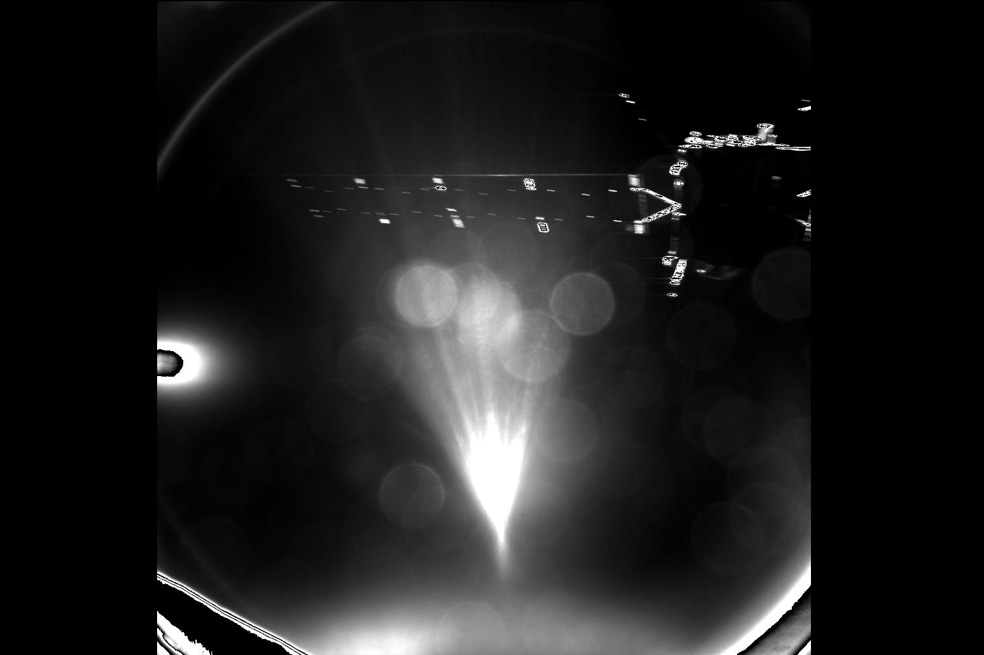
A handout picture released by the European Space Agency (ESA) on November 12, 2014 shows Europe's Rosetta spacecraft pictured by its robot craft Philae shortly after separation and with about 10 m between the two probes. The image was taken with the landers CIVA-P imaging system and captures almost all of the full length of one of the orbiter's 14 metre-long solar wings. It was stored onboard the lander until the radio link was established with Rosetta around two hours after separation, and then relayed to Earth. The lander separated from the orbiter at 09:03 GMT/10:03 CET and is expected to touch down on Comet 67P/ChuryumovGerasimenko seven hours later. Confirmation of a successful touchdown is expected in a one-hour window centred on 16:02 GMT / 17:02 CET. Rosetta and Philae had been riding through space together for more than 10 years. While Philae is set to become the first probe to land on a comet, Rosetta is already the first to rendezvous with a comet and follow it around the Sun. The information collected by Philae at one location on the surface will complement that collected by the Rosetta orbiter for the entire comet. AFP PHOTO / ESA/Rosetta/Philae/CIVA
— RESTRICTED TO EDITORIAL USE – MANDATORY CREDIT " AFP PHOTO / ESA/Rosetta/Philae/CIVA" – NO MARKETING NO ADVERTISING CAMPAIGNS – DISTRIBUTED AS A SERVICE TO CLIENTS —
Foto: AFP - HO
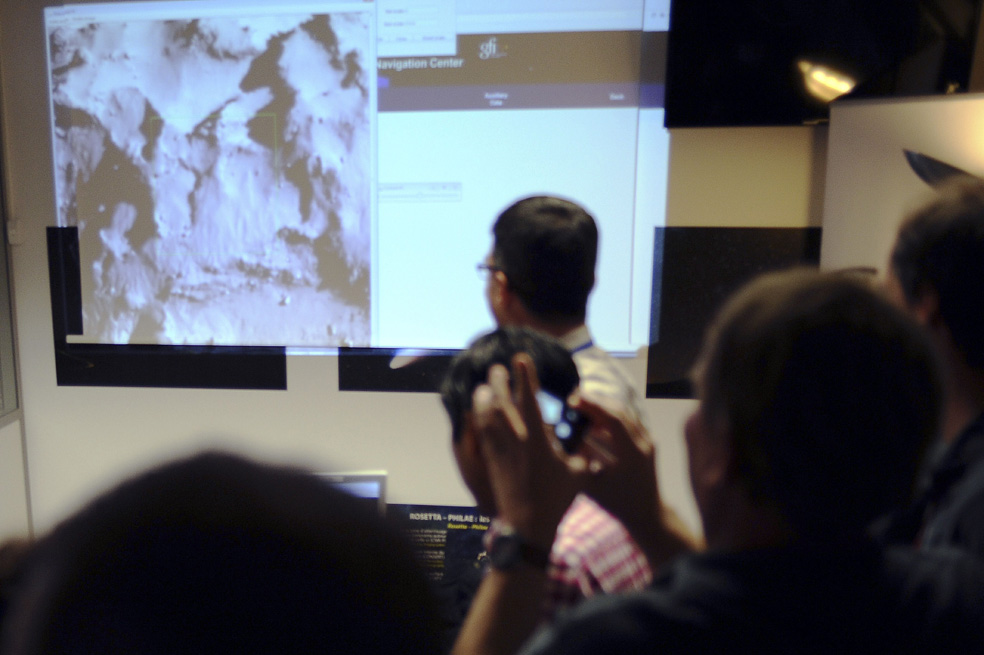
Scientists look at the first picture transmitted by the European Space Agency's (ESA) robot craft Philae, in the scientific mission observation centre of the French space agency Centre National d'Etudes Spatiales (CNES) in Toulouse, southern France, on November 12, 2014, as Philae carries out a 20-kms (12-mile) descent toward the Churyumov-Gerasimenko comet after being launched from space probe Rosetta, following a 10-year journey. Europe's Rosetta spacecraft made contact with its robot craft Philae soon after the lander embarked on November 12 on a solo, seven-hour descent to a comet, ground controllers said. Astrophysicists hope Philae will unlock knowledge about the origins of the Solar System and even life on Earth, which some believe may have started with comets "seeding" the planet with life-giving carbon molecules and water. AFP PHOTO / REMY GABALDA
Foto: AFP - REMY GABALDA

A handout photo released on November 12, 2014 by the European Space Agency shows Rosettas OSIRIS narrow-angle camera captured this parting shot of the Philae lander after separation. The lander separated from the orbiter at 09:03 GMT/10:03 CET and is expected to touch down on Comet 67P/ChuryumovGerasimenko seven hours later. Confirmation of a successful touchdown is expected in a one-hour window centred on 16:02 GMT / 17:02 CET. Rosetta and Philae had been riding through space together for more than 10 years. While Philae is set to become the first probe to land on a comet, Rosetta is the first to rendezvous with a comet and follow it around the Sun. The information collected by Philae at one location on the surface will complement that collected by the Rosetta orbiter for the entire comet. AFP PHOTO / ESA/Rosetta/MPS for OSIRIS Team MPS/UPD/LAM/IAA/SSO/INTA/UPM/DASP/IDA
— RESTRICTED TO EDITORIAL USE – MANDATORY CREDIT " AFP PHOTO / ESA/Rosetta/MPS for OSIRIS Team MPS/UPD/LAM/IAA/SSO/INTA/UPM/DASP/IDA" – NO MARKETING NO ADVERTISING CAMPAIGNS – DISTRIBUTED AS A SERVICE TO CLIENTS —
Foto: AFP - –
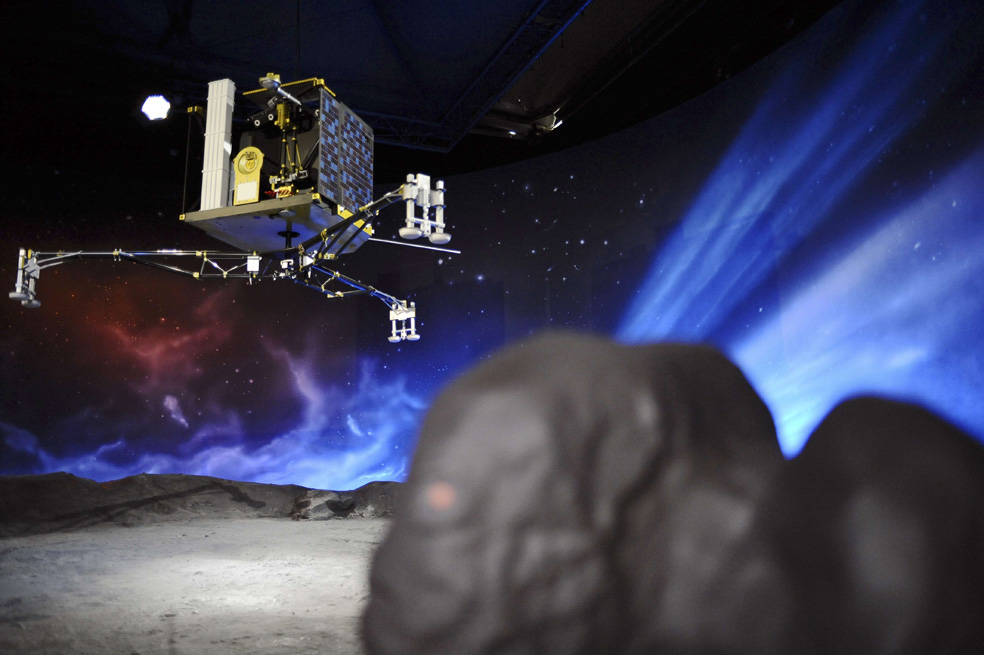
A picture shows a model of the European Space Agency's (ESA) robot craft Philae at the Cite de l'espace (Space City) in Toulouse, southern France, on November 12, 2014, the day Philae began a 20-kilometre (12-mile) descent toward the Churyumov-Gerasimenko comet after being launched from the space probe Rosetta, following a ten year journey. Europe's Rosetta spacecraft made contact with its robot craft Philae soon after the lander embarked on November 12 on a solo, seven-hour descent to a comet, ground controllers said. Astrophysicists hope Philae will unlock knowledge about the origins of the Solar System and even life on Earth, which some believe may have started with comets "seeding" the planet with life-giving carbon molecules and water. AFP PHOTO / REMY GABALDA
Foto: AFP - REMY GABALDA
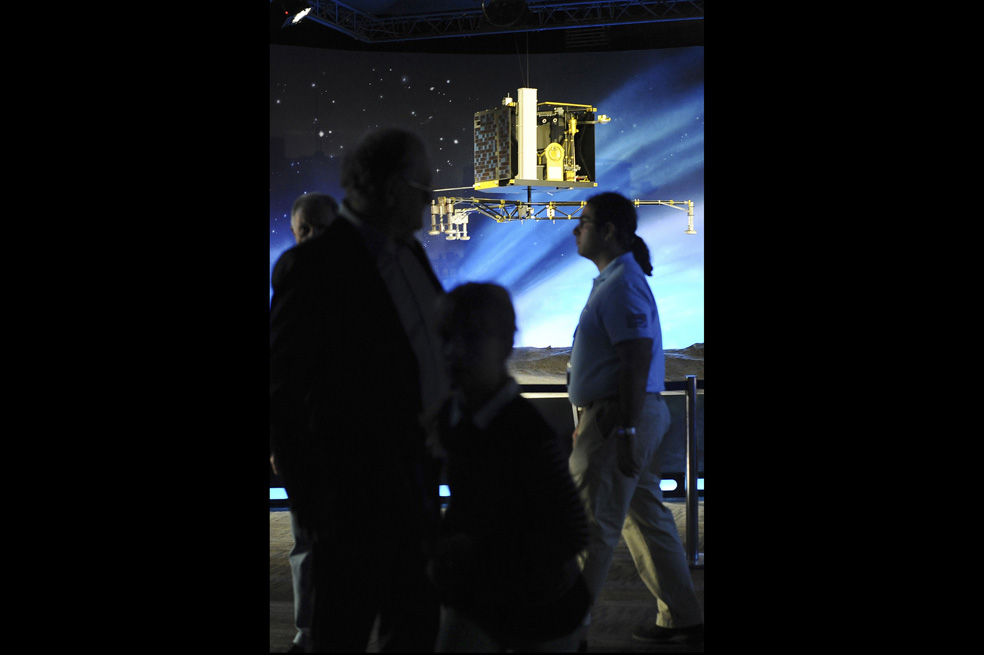
People stand next to a model of the European Space Agency's (ESA) robot craft Philae as they visit the Cite de l'espace (Space City) in Toulouse, southern France, on November 12, 2014, the day Philae began a 20-kilometre (12-mile) descent toward the Churyumov-Gerasimenko comet after being launched from the space probe Rosetta, following a ten year journey. Europe's Rosetta spacecraft made contact with its robot craft Philae soon after the lander embarked on November 12 on a solo, seven-hour descent to a comet, ground controllers said. Astrophysicists hope Philae will unlock knowledge about the origins of the Solar System and even life on Earth, which some believe may have started with comets "seeding" the planet with life-giving carbon molecules and water. AFP PHOTO / REMY GABALDA
Foto: AFP - REMY GABALDA
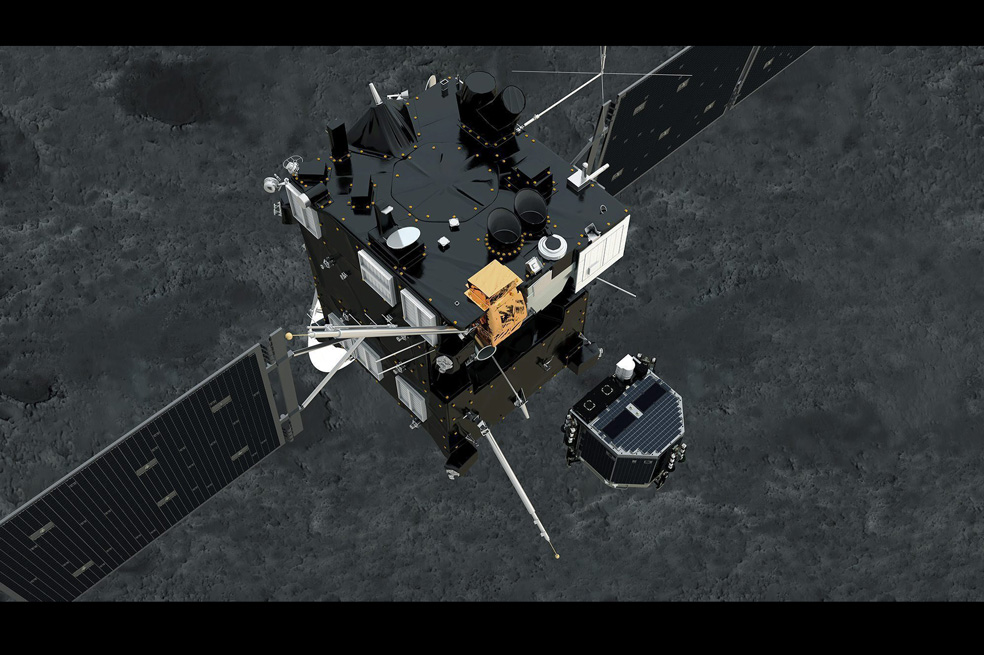
PH001 DARMSTADT (ALEMANIA) 12/11/2014.- Fotografía sin fechar facilitada por la Agencia Espacial Europea (ESA) de un fotograma de la animación del módulo Philae mientras se separa de Rosetta y desciende sobre la superficie del cometa 67/P Churyumov-Gerasimenko. El módulo Philae sigue vivo en la dirección correcta hacia el cometa 67/P Churyumov-Gerasimenko, en el que aterrizará sobre las 16.00 horas GMT para estudiar su composición. EFE/Esa / Atg Medialab / FOTO CEDIDA SOLO USO EDITORIAL PROHIBIDA SU VENTA
Foto: EFE - ESA / ATG MEDIALAB / HANDOUT

PH002 DARMSTADT (ALEMANIA) 12/11/2014.- Fotografía sin fechar facilitada por la Agencia Espacial Europea (ESA) de un fotograma de la animación del módulo Philae mientras se separa de Rosetta y desciende sobre la superficie del cometa 67/P Churyumov-Gerasimenko. El módulo Philae sigue vivo en la dirección correcta hacia el cometa 67/P Churyumov-Gerasimenko, en el que aterrizará sobre las 16.00 horas GMT para estudiar su composición. EFE/Esa / Atg Medialab / FOTO CEDIDA SOLO USO EDITORIAL PROHIBIDA SU VENTA
Foto: EFE - ESA / ATG MEDIALAB / HANDOUT
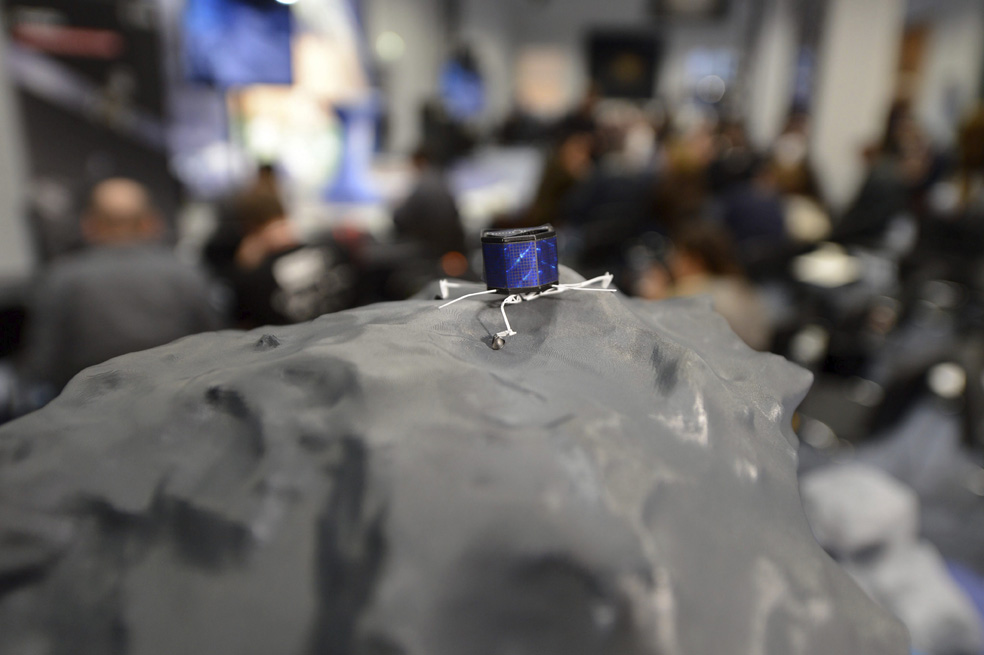
ADE001 DARMSTADT (ALEMANIA) 12/11/2014.- Una maqueta representa el aterrizaje del módulo Philae sobre el cometa 67P/ Churyumov-Gerasimenko durante una presentación a la prensa en el centro de control de satélites de la Agencia Espacial Europea (ESA) en Darmstadt (Alemania) hoy, miércoles 12 de noviembre de 2014. La sonda europea Rosetta ha lanzado hoy el módulo Philae sobre el citado cometa a una distancia de 22 kilómetros. La ESA va a estudiar en detalle el desarrollo de la coma del cometa, averiguar el agua que tiene dentro y la expulsión, ver qué tipo de agua es y si es como la de la Tierra, ya que en caso de que sea así fueron los cometas los que trajeron el agua a la Tierra. EFE/Arne Dedert
Foto: EFE - ARNE DEDERT
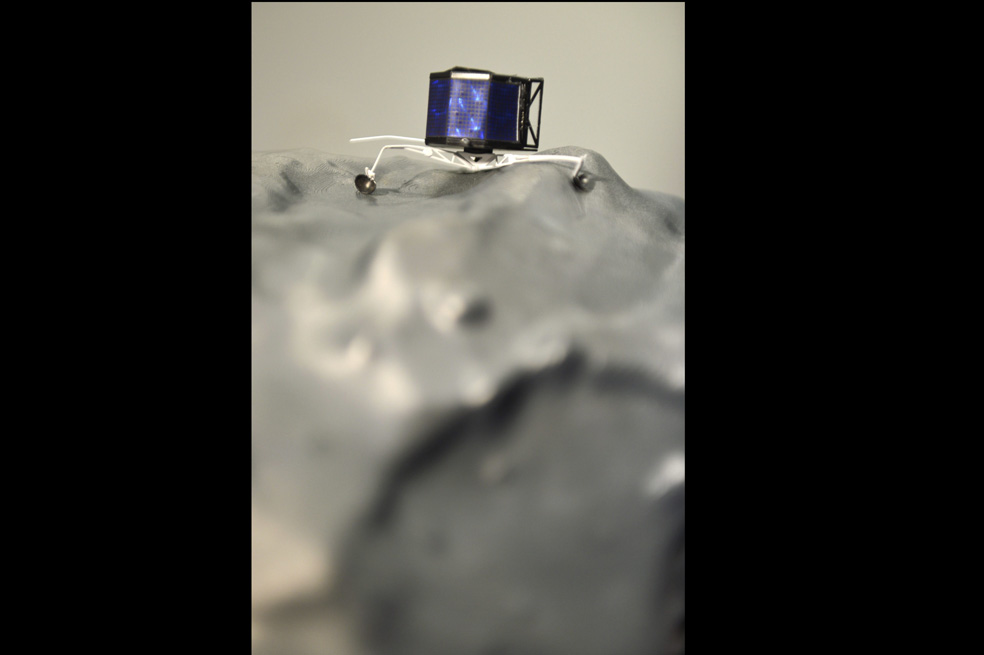
ADE002 DARMSTADT (ALEMANIA) 12/11/2014.- Una maqueta representa el aterrizaje del módulo Philae sobre el cometa 67P/ Churyumov-Gerasimenko durante una presentación a la prensa en el centro de control de satélites de la Agencia Espacial Europea (ESA) en Darmstadt (Alemania) hoy, miércoles 12 de noviembre de 2014. La sonda europea Rosetta ha lanzado hoy el módulo Philae sobre el citado cometa a una distancia de 22 kilómetros. La ESA va a estudiar en detalle el desarrollo de la coma del cometa, averiguar el agua que tiene dentro y la expulsión, ver qué tipo de agua es y si es como la de la Tierra, ya que en caso de que sea así fueron los cometas los que trajeron el agua a la Tierra. EFE/Arne Dedert
Foto: EFE - ARNE DEDERT

Scientists celebrate in the scientific mission observation centre of the French space agency Centre National d'Etudes Spatiales (CNES) in Toulouse, southern France, on November 12, 2014, as they receive information that the European Space Agency's (ESA) robot craft Philae has landed on the Churyumov-Gerasimenko comet after a 20-kilometre (12-mile) descent from its carrier the European space probe Rosetta, following a ten year journey. The European probe Philae has made the first-ever landing on a comet, a crowning phase in a quest to explore the origins of the Solar System, the European Space Agency (ESA) said on November 12. Scientists hope the lander, equipped with 10 instruments, will unlock the secrets of comets — primordial clusters of ice and dust that may have helped sow life on Earth. AFP PHOTO / REMY GABALDA
Foto: AFP - REMY GABALDA
Comentarios
Sin comentarios aún. Suscríbete e inicia la conversación